The Conditional Humanity of Settler Society
I've been thinking a lot about Empire lately; specifically, the deeply personal way people defend it. This thought was spurred by a pair of white men having an overtly racist conversation in a courthouse hallway in North Carolina while I was on the phone with my partner this morning, and by that famous quote from John F. Kennedy: “Ask not what your country can do for you, but what you can do for your country.”
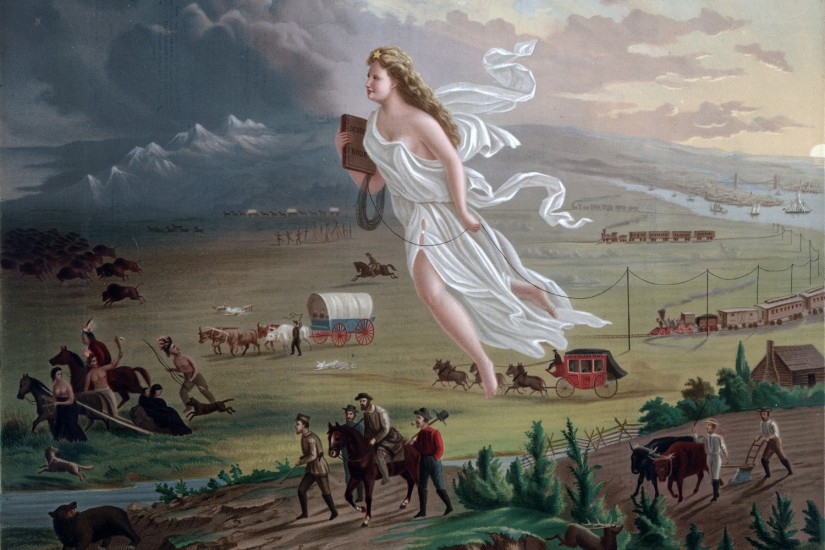
Historically, white men have operated as the primary architects, managers, and beneficiaries of the American empire. European settlers arrived on Indigenous land and established their society through conquest, removal, enslavement, and extermination. The wealth that built the United States did not emerge naturally from “hard work” or “innovation,” but from stolen land and enslaved labor. Entire fortunes, industries, railroads, banks, universities, and political institutions were financed through plantation slavery and westward expansion. Yet empire survives not only through force, but through mythology.
The mythology is important. The average settler is not taught to understand the American empire as a colonial project; they are taught to see it as the natural expression of freedom and civilization itself. Whiteness in America became more than skin color: it became a political relationship to power and belonging; a unified and expressed theory of identity. To be white is to be positioned closer to the category of “real American,” closer to the state, and farther from the populations marked for exploitation and elimination. This is why critiques of empire are often experienced not as political disagreements, but as personal attacks.
You can see this dynamic clearly in racist reactions toward Puerto Ricans, immigrants, Black people, Indigenous people, or anyone perceived as “outside” the imagined national body. Puerto Rico is treated by many mainland Americans as a possession: useful for labor, military recruitment, tourism, and extraction, but disposable the moment Puerto Ricans assert political agency or demand dignity. The racism directed at Puerto Ricans often carries a colonial logic beneath it; the assumption that the island exists for the mainland’s benefit, and that Puerto Ricans should be grateful for incorporation into the empire that subordinated them in the first place.
The same logic appears whenever the violence of settler colonialism is mentioned. Remind settlers that the United States exists because Europeans arrived on Indigenous land and carried out genocide, and the response is often visceral. Suddenly the conversation shifts into defensive myths: “Africans had slaves too,” “Everyone conquered everyone,” “survival of the fittest,” “that was a long time ago.” These responses are personal and ideological reflexes. They exist to protect identification with empire from moral scrutiny. If the foundations of the country are illegitimate, then what does it mean to emotionally merge oneself with that country? What does it mean to say “we” when talking about conquest, war, domination, and empire?
The settler believes with his whole heart that he possesses some personal stake in the empire itself. When the American empire landed on the moon, it became “we landed on the moon.” When the American military bombs another country, it becomes “we are at war.” National achievement and imperial violence alike are internalized as personal identity. And because empire is experienced as an extension of the self, threats to empire provoke panic, resentment, and scapegoating. The foreigner, the immigrant, queer people, communists, “degenerates,” the supposedly disloyal; all become convenient explanations for imperial decline. The contradictions of capitalism and colonialism are displaced onto marginalized people. The rot at the core of the system is not confronted directly.
In this context, the JFK quote changes a bit. It's "ask not what white men can do for you, ask what you can do for white men." Or more bluntly: ask what you can do for whiteness, for settler society, for the continuation of the existing order. The promise offered in return is belonging, respectability, safety, and a place within the national body. But that belonging is conditional.
Settler-colonial capitalism does not actually offer unconditional humanity even to many settlers themselves. It offers proximity to power in exchange for obedience, conformity, and usefulness. A settler can be celebrated as a patriot, a worker, a soldier, or a “good American,” but only so long as they remain legible to the dominant order. The moment some supposedly disqualifying trait emerges, such as queerness, disability, poverty, political dissidence, mental illness, criminalization, failure, or dependency, the mask slips. The same society that demanded loyalty reveals how disposable that person always was.
That contradiction is visible in the story of Oliver Sipple. Here was a man who embodied many of the values the empire claims to honor: a Marine veteran who intervened to save the life of the President of the United States. Sipple had served in Vietnam, and intervened in the attempted assassination of President Gerald Ford by Sara Jane Moore. He acted decisively in defense of the state itself. And yet the thing that came to define his public treatment was not his heroism, but his homosexuality. Once exposed as gay by the media, he was subjected to humiliation, rejection, and isolation. The empire could thank him for his service while simultaneously destroying his social life. His loyalty did not protect him because loyalty alone is never enough. Empire also demands conformity to its social hierarchy.
This is one of the central contradictions of settler society. It encourages settlers to emotionally identify with the state as though they share ownership over it, as though its victories are their victories and its power belongs to them personally. But in reality, most people remain subordinate to systems far larger than themselves. They are valued instrumentally: useful workers, useful soldiers, useful voters, useful consumers. Once they cease being useful, or once they disrupt the image of the ideal settler subject, they become expendable.
Under settler-colonial capitalism, there are populations whose suffering is foundational and permanent. Black people are subjected to anti-Blackness. Indigenous people are targeted through elimination and erasure. Colonized peoples are exploited for labor and resources. Queer and trans people are disciplined for violating patriarchal social norms. They bear the sharpest edge of violence because the system materially depends on their oppression. But the system also produces a broader culture of disposability that eventually reaches many others as well. The empire consumes endlessly because it is structurally incapable of recognizing human beings outside of their usefulness to accumulation, order, and domination.
That does not mean oppression is equalized. A white settler rejected by empire is not subjected to the same historical violence as colonized peoples. But it does reveal something important: empire cannot ultimately provide genuine liberation or security even to many of those raised to defend it most fiercely. The bargain it offers is inherently unstable. It says: identify with power, defend power, sacrifice for power, and perhaps you will be spared. Perhaps you will belong. But belonging can always be revoked.
That is why opposition to empire cannot emerge solely from the populations most violently targeted by it, though they remain at the forefront of struggle. It must also involve settlers willing to break identification with domination itself, to stop seeing empire as an extension of themselves, to reject the inheritance of conquest, and to understand liberation not as inclusion within imperial power, but as the dismantling of the structures that require domination in the first place.
Comrade Alexandria R. is a member of Cleveland DSA and Co-Chair of Liberation Caucus.